Skip List Performance
C++ Performance
The time performance tests are run as follows:
 1$ cd src/cpp
 2$ make release
 3$ ./SkipList_R.exe
 4                 test_very_simple_insert(): PASS
 5                                                    ...
 6                 test_roll_med_even_mean(): PASS
 7               perf_single_insert_remove(): 451.554 (ms) rate x.xe+06 /s
 8                                                    ...
 9            perf_roll_med_odd_index_wins(): vectors length:  1000000 window width: 524288 time: x.x (ms)
10                            perf_size_of(): size_of(       1):      216 bytes ratio:      216 /sizeof(T):       x
11                                                    ...
12Final result: PASS
13Exec time: x.x (s)
14Bye, bye!
The ouptut is a combination of test results, performance results and dot visualisations
If multi-threaded support is enabled (see Multi-threaded C++ Performance below) the execution time including the multi-threaded tests takes about three minutes. With single threaded support the tests take around two minutes. If the debug version is built the performance tests are omitted as the cost of integrity checking at every step is very high which would make the performance test data irrelevant.
Time Performance
The performance test mostly work on a SkipList of type double that has 1 million values.
Test on a couple of modern 64 bit OS’s [Linux, Mac OS X] show that the cost of SkipList operations is typically as
follows.
Mutating operations: insert(), remove()
Doubles
These operations depend on the size of the SkipList. For one containing 1 million doubles each operation is typically 450 ns (2.2 million operations per second).
Here is a graph showing the cost of the combined insert() plus remove() of a value in different places in a
SkipList of doubles with differing lengths of the SkipList.
A SkipList 1m long of doubles represents 8MB data (the doubles) but totals around 100MB of data including the SkipList
nodes.
The candlesticks are calculated thus:
The lowest point is the minimum value of several repeats (typically 10). This is the mose relevant time as it represents the time free of CPU contention.
The lowest box value is the mean value minus the standard deviation of several repeats (typically 10).
The highest box value is the mean value plus the standard deviation of several repeats (typically 10).
The highest point is the maximum value of several repeats (typically 10).
The test functions are in src/cpp/test/test_performance.cpp:
perf_test_double_insert_remove_value_begin()inserts and removes from the beginning of the list.perf_test_double_insert_remove_value_mid()inserts and removes from the middle of the list.perf_test_double_insert_remove_value_end()inserts and removes from the end of the list.
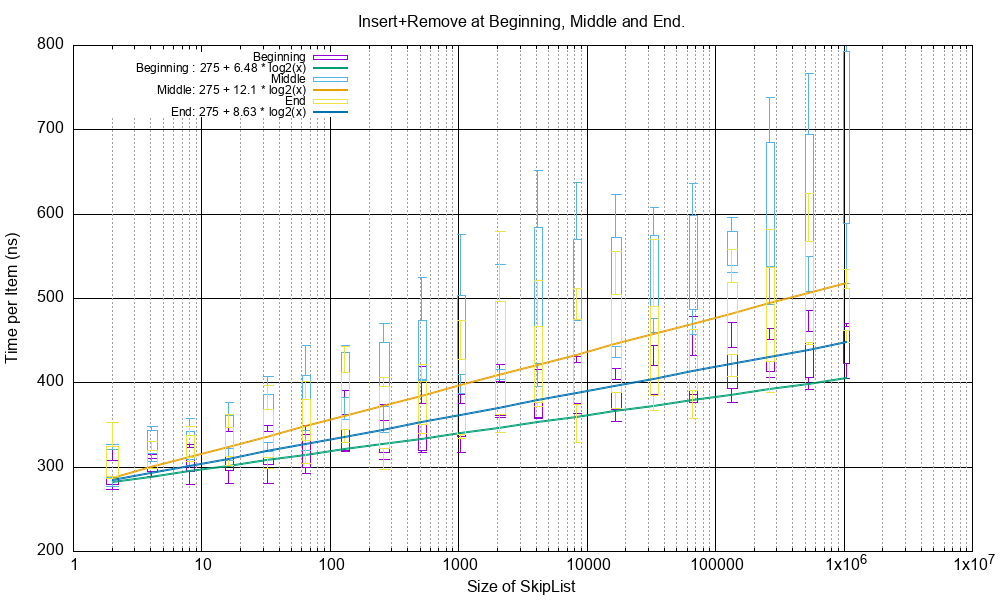
The lines on the graph depict the minimum values of several test repeats. This shows good O(log(n)) behaviour where n is the SkipList size. As expected inserting and removing in the middle is more costly because of the more complicated search setup.
Strings
Here is a graph showing the cost of the combined remove() plus insert() of a string in different
places in a SkipList of strings with differing lengths of the SkipList.
The strings are 1024 bytes long of random printable characters.
Thus a SkipList 16384 long with 1024 bytes strings holds 16 MB of data.
On top of that is the SkipList nodes (including the std::string object but not including any dynamically allocated
memory) which is around 2MB of data. This makes a total of 18MB.
Note
This test first populates a SkipList with N random strings. It then identifies the string at the beginning/middle/end as appropriate, removes it and then re-inserts it.
The test functions are in src/cpp/test/test_performance.cpp:
perf_test_string_insert_remove_value_begin()inserts and removes from the beginning of the list.perf_test_string_insert_remove_value_mid()inserts and removes from the middle of the list.perf_test_string_insert_remove_value_end()inserts and removes from the end of the list.
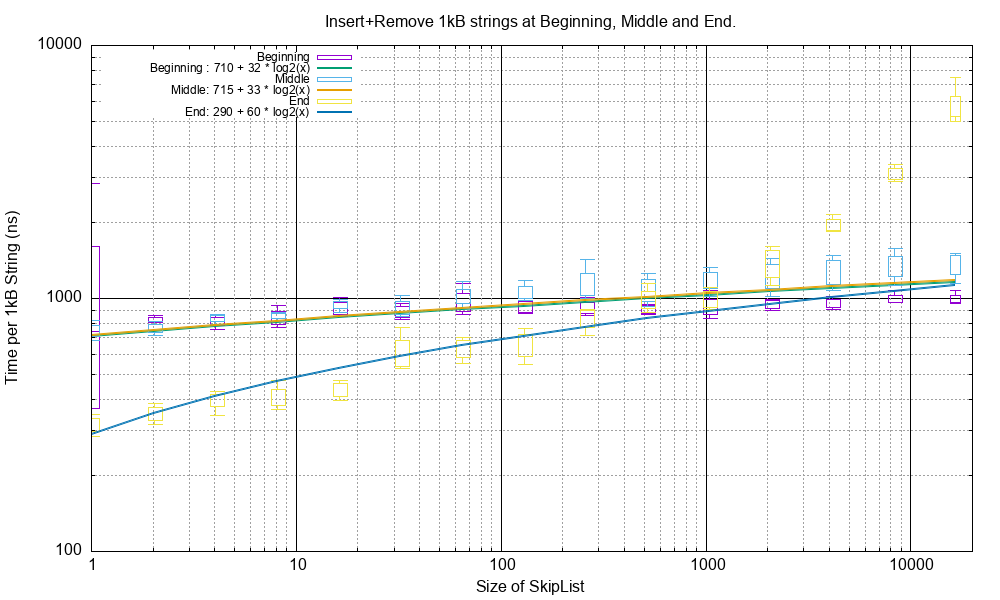
Notes:
Inserting at the beginning or in the middle takes the same time and exhibits O(log(N)) behaviour.
Inserting at the end is significantly faster with SkipLists with up to 4096 strings in them. It also exhibits O(log(N)) behaviour in this range.
Inserting at the end with SkipLists with more than 4096 strings in them starts to exhibit O(N) behaviour. Additionally the range between maximum test time and minimum test time increases to 2:1 or more. Also the standard deviation of test times increases sharply with these SkipList lengths. I know not why this should be.
Todo
Investigate this O(N) behaviour when inserting strings at the end of a SkipList.
Indexing operations: at(), has() index()
These operations on a SkipList containing 1 million doubles is typically 220 ns (4.6 million operations per second).
vs Location
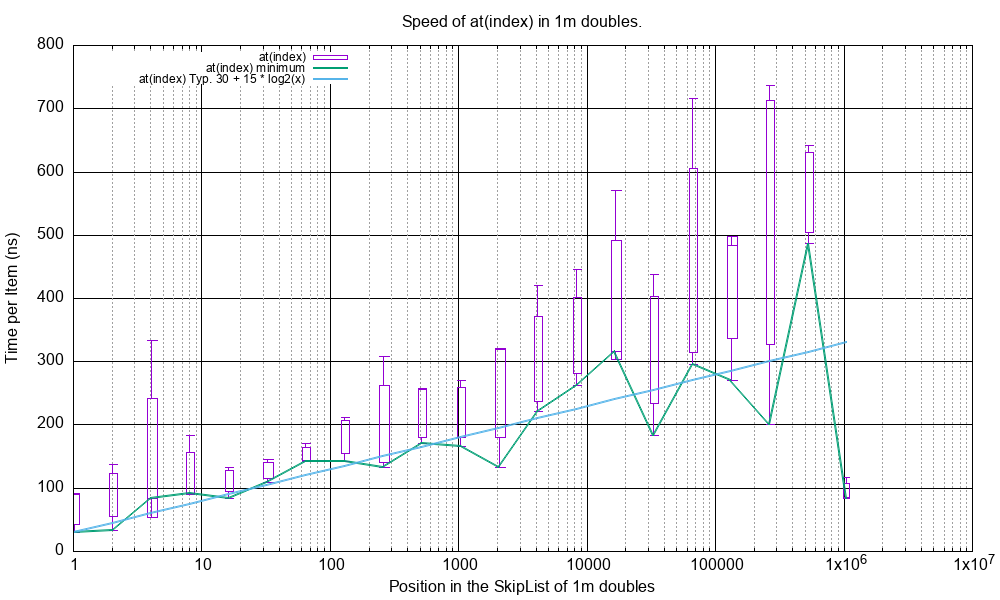
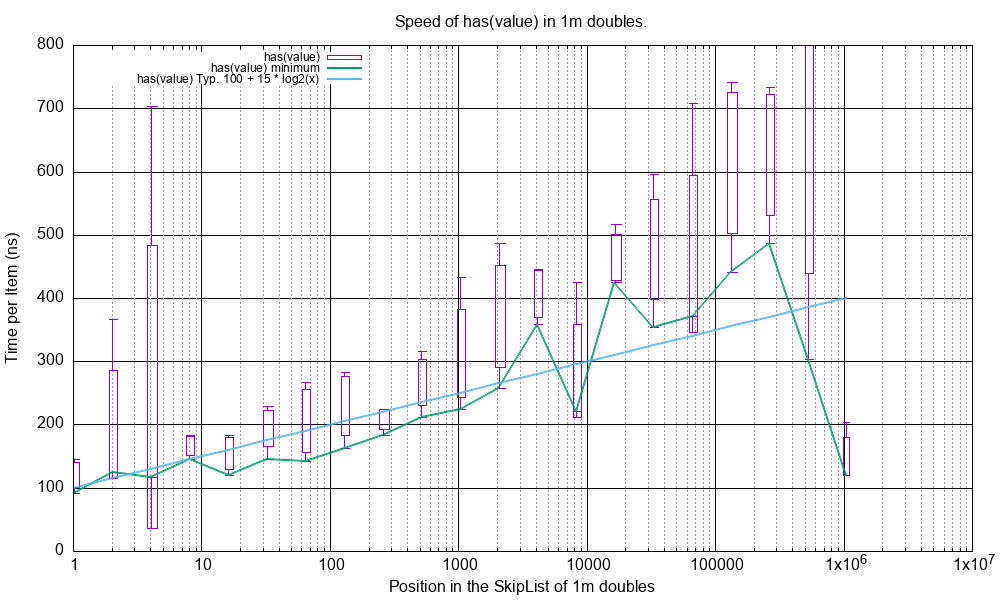
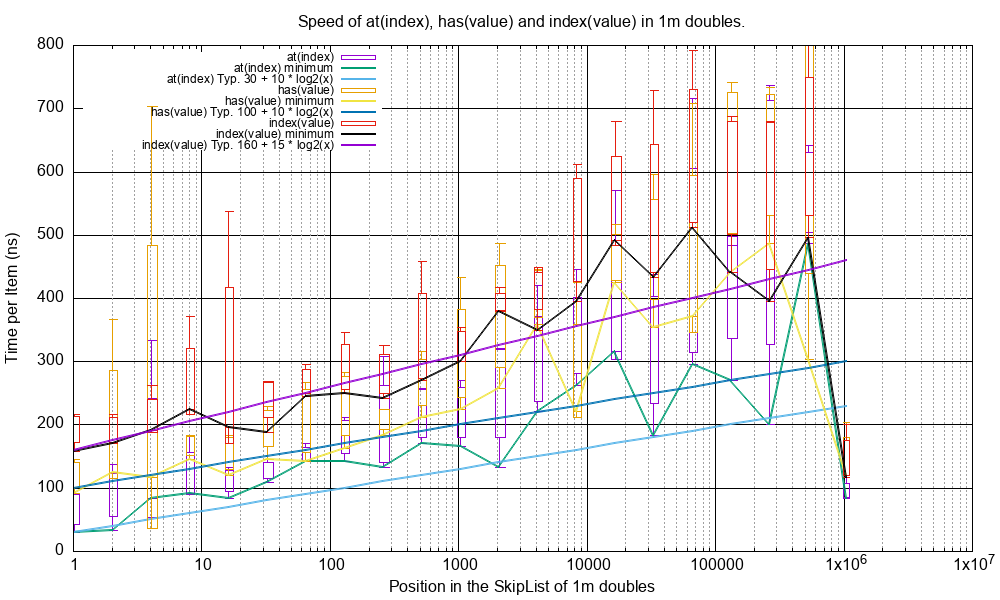
Here is plot of the time taken to execute at(index), has(value) and index(value) on a SkipList of 1 million
doubles where the X-axis is the position in the SkipList of the found double.
The test functions are in src/cpp/test/test_performance.cpp:
perf_test_double_at_1m_all().perf_test_double_has_1m_all().perf_test_double_index_1m_all().
at(index)
This shows the range, minimum and trend of at(index).
has(value)
This shows the range, minimum and trend of has(value).
index(value)
This shows the range, minimum and trend of index(value).
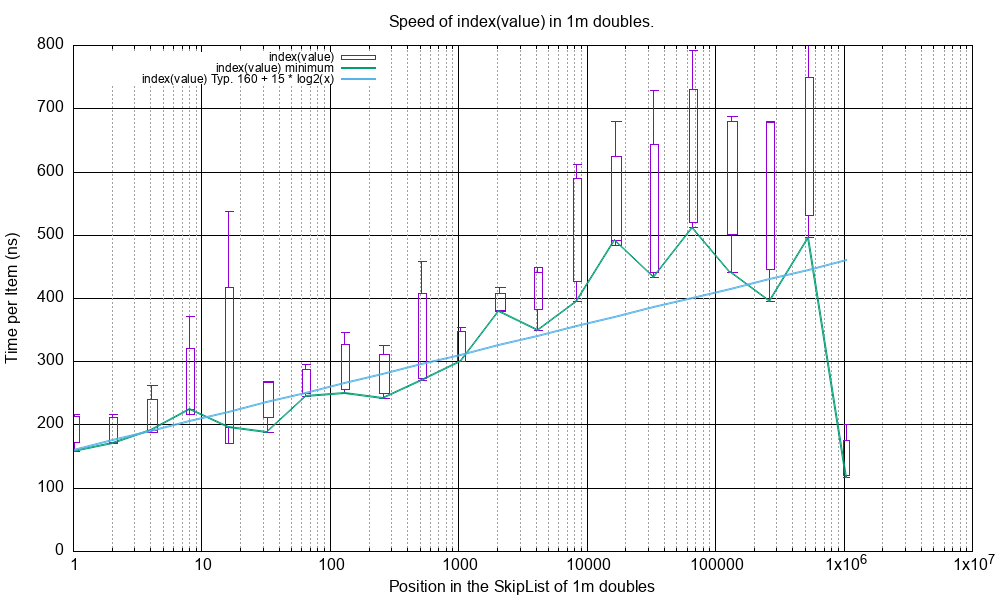
These all show good O(log(n))’ish type behaviour.
In summary:
Operation |
Offset (ns) |
Scale * log2(size) |
|---|---|---|
|
30 |
15 |
|
100 |
15 |
|
160 |
15 |
Here is the performance of all three operations shown together:
Todo
Investigate why there is a huge performance increase when the length is specifically 1048576 (1 << 20).
Rolling Median
See the section C++ Performance for the rolling median performance in C++ and Python Performance for Python.
Space Complexity
Space usage is a weakness of SkipLists. There is a large amount of bookkeeping involved with multiple node pointers plus the width values for each node for an indexed SkipList.
Theoretical Memory Usage for double
The space requirements for a SkipList of doubles can be estimated as follows.
t = sizeof(T)~ typ. 8 bytes for a double.v = sizeof(std::vector<struct NodeRef<T>>)~ typ. 32 bytes.p = sizeof(Node<T>*)~ typ. 8 bytes.e = sizeof(struct NodeRef<T>)~ typ. 8 + p = 16 bytes.
Then each node: is t + v bytes.
Linked list at level 0 is e bytes per node and at level 1 is, typically, e / 2 bytes per node
(given p() as a fair coin) and so on.
So the totality of linked lists is about 2 * e bytes per node.
Then the total is N (t + v + 2 e) which for T as a double is typically 72 bytes per item.
Memory usage can be gauged by any of the following methods:
Theoretical calculation such as above which gives ~72 bytes per node for doubles.
Observing a process that creates a SkipList using OS tools, this typically gives ~86 bytes per node for doubles.
Calling the
size_of()method that can make use of its knowledge of the internal structure of a SkipList to estimate memory usage. Fordoublethis is shown to be about 76 bytes per node. Anysize_of()estimate will be an underestimate if the SkipList<T>uses dynamic memory allocation such asstd::string.
Estimate Memory Usage With size_of()
This implementation of a SkipList has a size_of() function that estimates the current memory usage of the SkipList.
This function uses sizeof(T) which will not account for any dynamically allocated content, for example if T was
a std::string.
Total memory allocation is a function of a number of factors:
Alignment issues with the members of
class Nodewhich has membersT _value;andSwappableNodeRefStack<T> _nodeRefs;. IfTwas achartype then alignment issues on 64 bit machines may mean thechartakes eight bytes, not one.The size of the SkipLists, very small SkipLists carry the overhead of the
HeadNode.The coin probability
p(). Unfair coins can change the overhead of the additional coarser linked lists. More about this later.
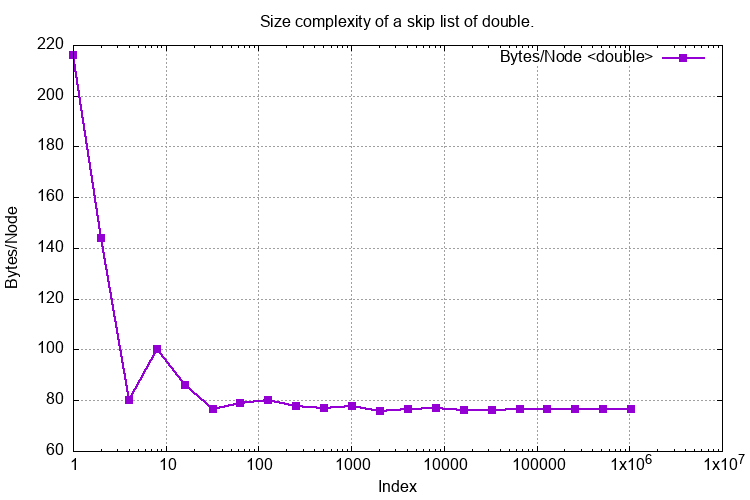
The following graph shows the size_of() a SkipList of doubles of varying lengths with a fair coin.
The Y axis is the size_of() divided by the length of the SkipList in bytes per node.
Fairly quickly this settles down to around 80 bytes a node or around 10 times the size of a single double.
The test name is perf_size_of().
Height Distribution
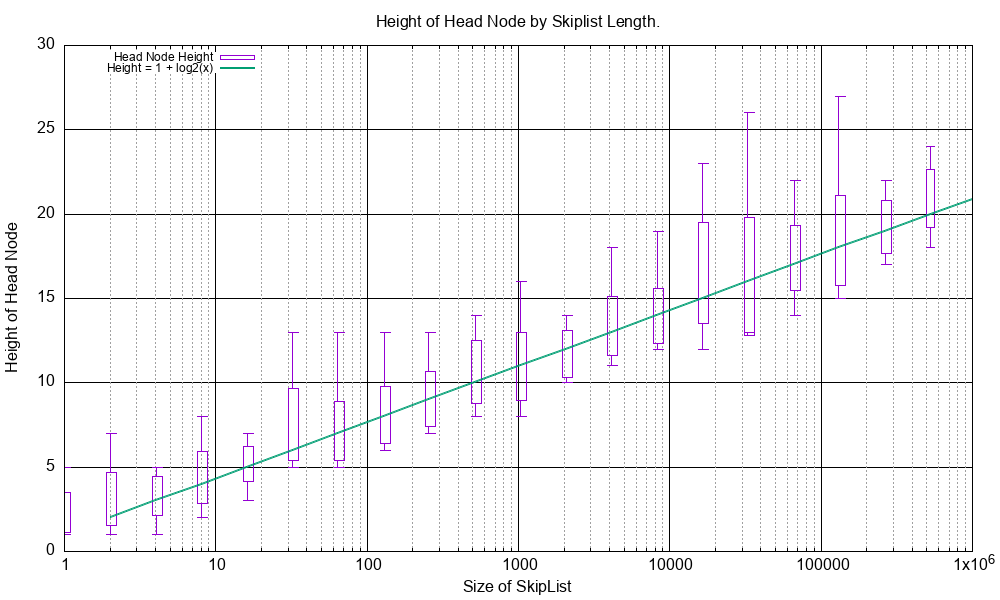
This graph shows the height growth of the SkipList where the height is the number of additional coarse linked lists.
It should grow in a log(n) fashion and it does.
The tests is perf_test_node_height_growth() in src/cpp/test/test_performance.cpp.
Effect of a Biased Coin
The default compilation of the SkipList uses a fair coin.
The coin toss is determined by tossCoin() in SkipList.cpp which has the following implementation:
bool tossCoin() {
    return rand() < RAND_MAX / 2;
}
The following biases can be introduced with these return statements:
p() |
Return statement |
|---|---|
6.25% |
|
12.5% |
|
25% |
|
50% |
|
75% |
|
87.5% |
|
For visualising what a SkipList looks like with a biased coin see Biased Coin Skip List Visualisations
Time Performance
The following graph plots the time cost of at(middle), has(middle_value), insert(), at(), remove() and the
rolling median (window size 101) all on a 1 million long SkipList of doubles against p() the probability of the
coin toss being heads. The time cost is normalised to p(0.5).
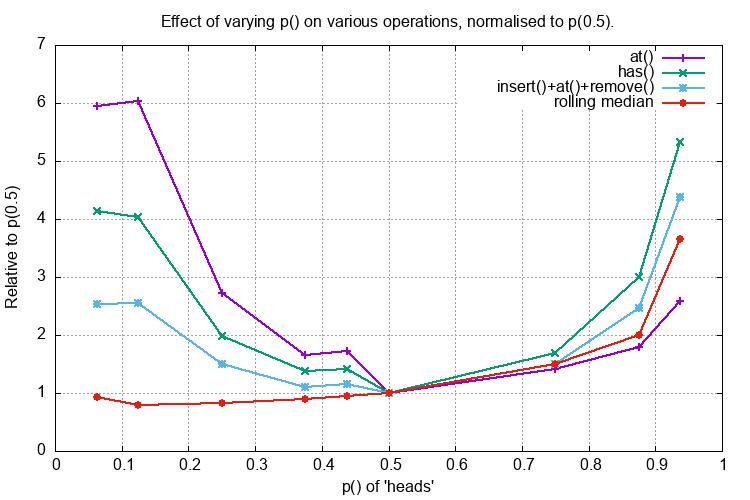
Reducing p() reduces the number of coarser linked lists that help speed up the search so it is expected that the
performance would deteriorate.
If p() was zero the SkipList would be, effectively, a singly linked list with O(n) search performance.
I do not understand why the rolling median performance appears to improve slightly when the rolling median is really
just an insert(), at(), remove() operation.
Increasing p() increases the number of coarser linked lists that might be expected to speed up the search.
This does not do so in practice, possible explanations are:
The increased cost of creating a node
The increased memory usage (see next section)
Poor locality of reference of the nodes.
Space Performance
Different values of p() greatly influences the space used as it directly affects the number of coarser linked lists
created.
In practice a reduction of p() provides some small space improvement.
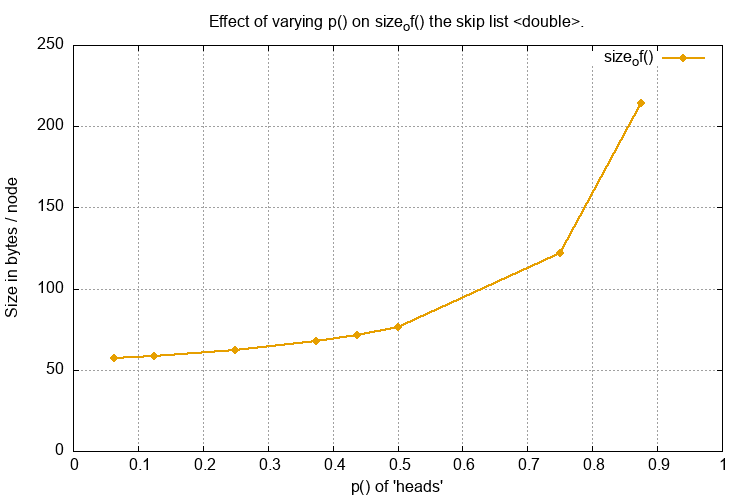
If the SkipList was highly optimised for rolling median operations it might be worth experimenting with p(0.25)
or even p(0.125) and evaluate the time/space requirements but otherwise there seems no reason, in the general case,
to use anything but p(0.5).
Multi-threaded C++ Performance
The C++ code is capable of multi-threading support where a single SkipList can be mutated by multiple threads.
The code must be compiled with the macro SKIPLIST_THREAD_SUPPORT defined.
Test C++ execution code can be run by invoking the the makefile thus:
 1$ cd src/cpp
 2$ make release CXXFLAGS=-DSKIPLIST_THREAD_SUPPORT
 3$ ./SkipList_R.exe
 4               ...
 5               test_single_thread_insert(): PASS
 6       test_two_thread_insert_has_remove(): PASS
 7      test_two_thread_insert_count_has_remove_count(): PASS
 8     test_perf_insert_count_has_remove_count_multi_threads_vary_length(): threads:    1 SkiplistSize:   131072 time:       180145 (us) rate       727592 /s
 9                                            ...
10    test_perf_single_thread_fixed_length(): PASS
11
12Final result: PASS
13Exec time: x.x (s)
14Bye, bye!
Note
If you omit CXXFLAGS=-DSKIPLIST_THREAD_SUPPORT then the threaded tests will be omitted:
$ make release
$ ./SkipList_R.exe
               ...
               test_single_thread_insert(): N/A
       test_two_thread_insert_has_remove(): N/A
      test_two_thread_insert_count_has_remove_count(): N/A
Effect of SKIPLIST_THREAD_SUPPORT
Here are several performance measurements when SKIPLIST_THREAD_SUPPORT is defined:
A multi-threaded capable SkipList in a single threaded environment.
A multi-threaded capable SkipList in a multi threaded environment where threads vie for the same SkipList.
To explore this we create a task that is to insert a unique double into an empty SkipList 2**14 (16384) times and then remove that number one by one to empty the SkipList. This task typically takes 18 ms (around 1 us per insert+remove).
This task will be repeated 1, 2, 4, … 64 times using single and multiple threads. The single threaded version is sequential, the multithreaded version creates simultaneous operations on the same SkipList.
The code for these tests is in test/test_concurrent.cpp.
A Single Threaded Environment
The sheer act of using -DSKIPLIST_THREAD_SUPPORT will introduce a mutex into the head node.
This will increase the time of any operation on the SkipList even when run in the single thread as there is a cost of
acquiring the mutex even in the absence of contention. The test function is test_perf_single_thread_fixed_length().
In the graph below the X axis is the number of times the task is repeated (sequentially).
The left Y axis is the total execution time with the SkipList in the main thread.
The right Y axis is the ratio: time with -DSKIPLIST_THREAD_SUPPORT / time without -DSKIPLIST_THREAD_SUPPORT
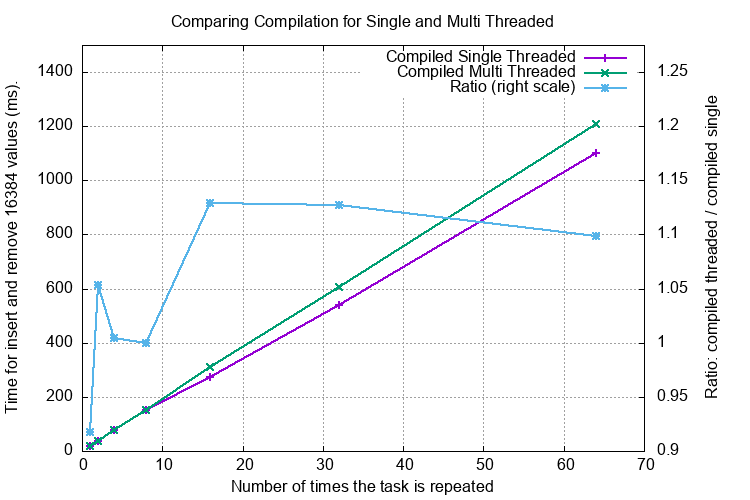
The overhead of using -DSKIPLIST_THREAD_SUPPORT is about 0% to 15%.
A Multi Threaded Environment
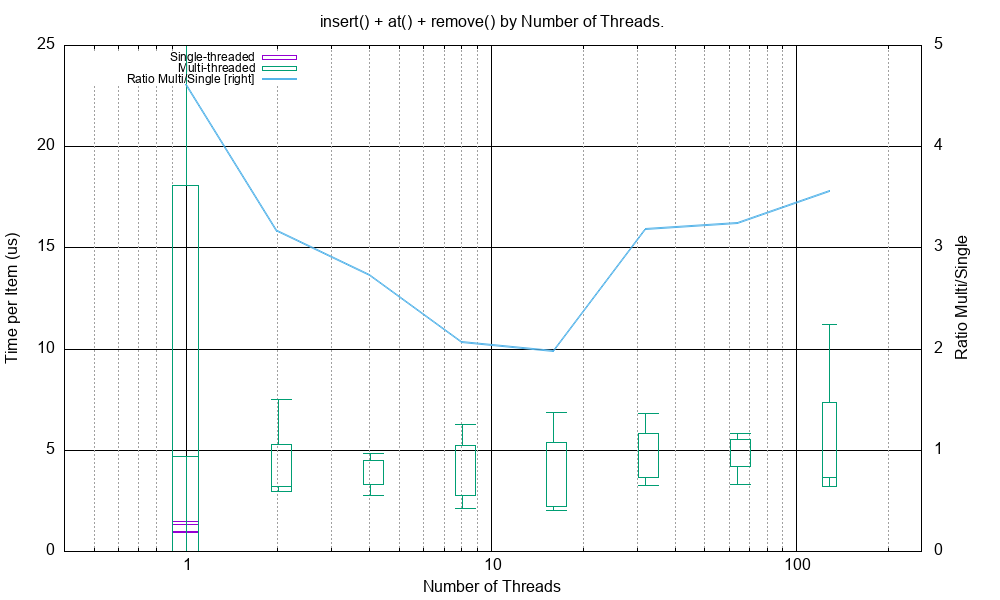
Here is a multi-threaded simulation of the operations typical of rolling median on a shared Skip List. Each thread:
Inserts a value at the mid-point of the same Skip List using
insert().Checks it has that value using
has().Removes that value using
remove()
Each of these operations obtains a lock on the Skip List.
Then repeating the task in 1, 2, 4, … 128 new threads simultaneously where they share the same Skip List.
The test function is _test_perf_sim_rolling_median_multi_thread().
In the graph below the Y-axis shows the cost for each insert/has/remove operation in microseconds against the number of threads contending for the SkipList, also shown is the same for a single threaded version (arbitrarily at 0.5 threads).
Python Performance
Time Performance
Here is the performance for Python 3.14 for calling insert(value), at(index), remove(value) at the beginning,
middle and end of the SkipList of 1m floats.
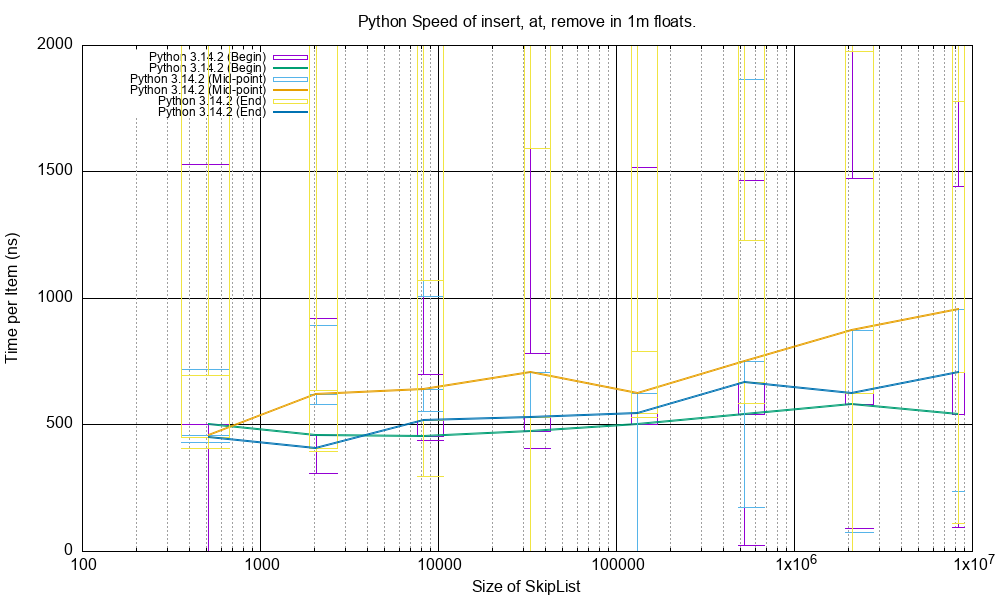
The time per operation is about 2x or 3x the C++ time.
By Python Version
For comparison here is the minimum recorded time for calling insert(value), at(index), remove(value) at the
middle of the SkipList for various Python versions.
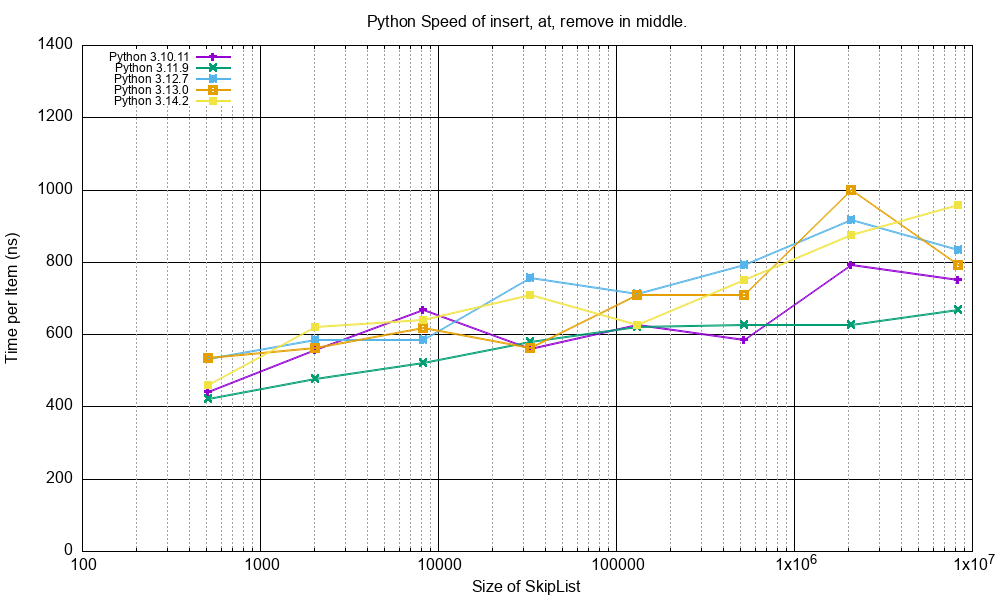
The Python version does not seems to have any significant effect on the performance.
Multi-Threaded Python Performance
Here is the performance for Python 3.14 for calling insert(value), has(value), remove(value) at the middle of
SkipList of 1m floats.
The same total number of values are inserted but this is spread across a number of threads.
The benchmark test is in:
tests.benchmarks.test_benchmark_SkipList_threaded.test_ihr_float_threaded().
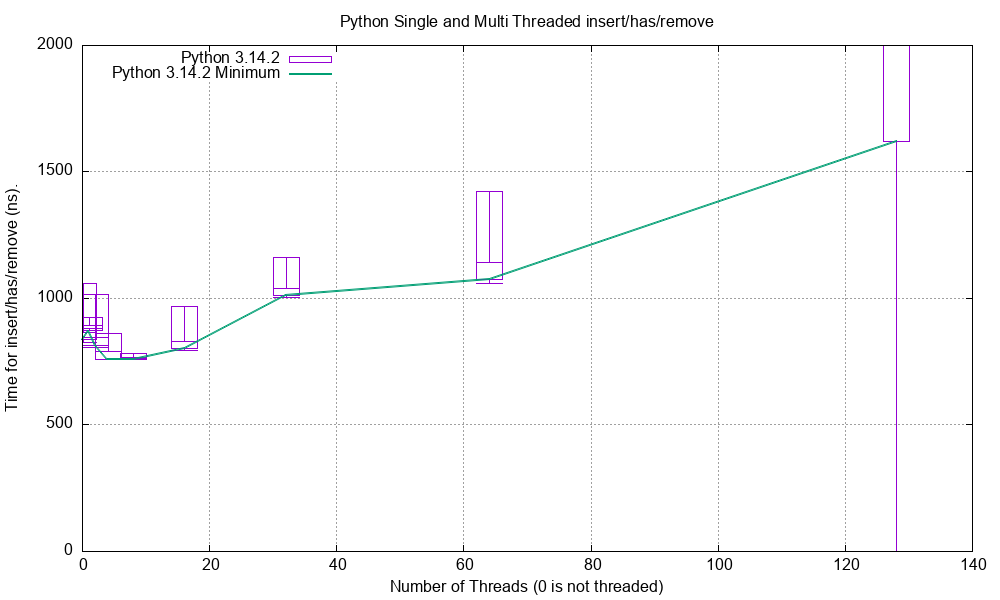
This shows the gradual overhead of thread contention of doing the same amount of work.
By Python Version
For comparison here is the minimum recorded time for calling insert(value), has(value), remove(value) at the
middle of the SkipList of 1m floats for various Python versions.
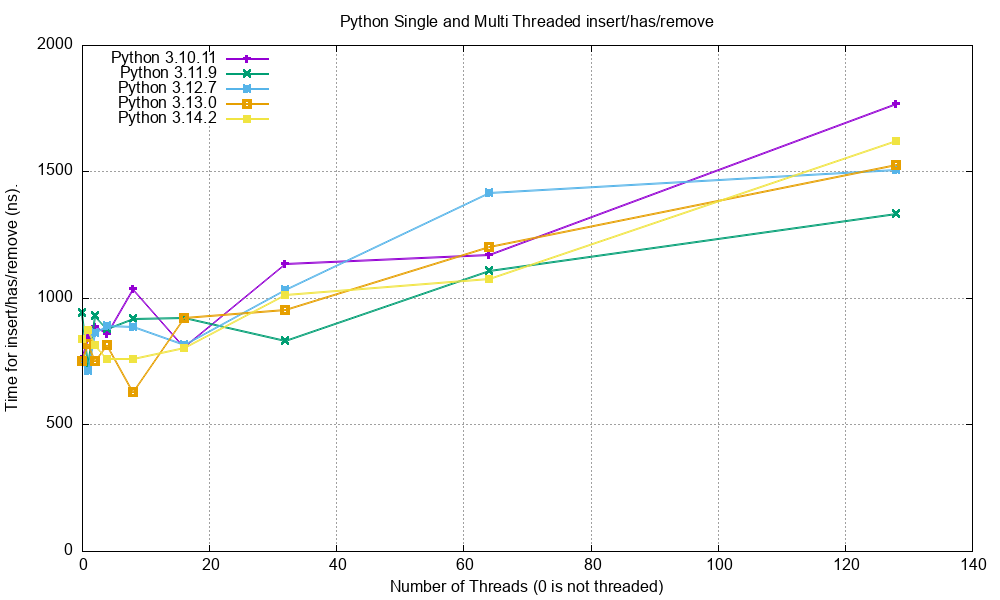
The Python version does not seems to have any significant effect on the performance.